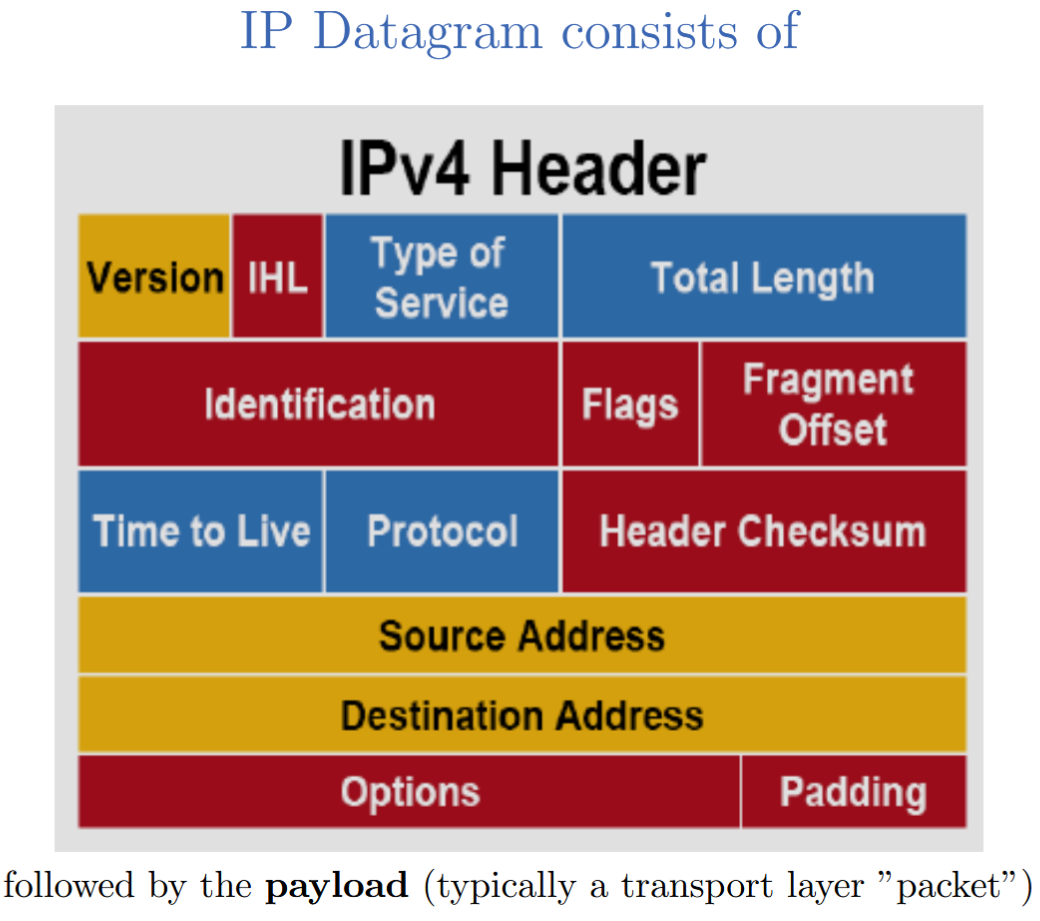
IP
The Internet Protocol (IP) is a fundamental protocol in the Internet Protocol Suite that is responsible for addressing and routing data packets across networks.
IP assigns unique numerical addresses, known as IP addresses, to devices on a network, allowing them to communicate with each other.
There are two main versions of IP in use today: IPv4 and IPv6. IPv4 uses 32-bit addresses, while IPv6 uses 128-bit addresses to accommodate the growing number of devices connected to the internet.
IP operates at the Network Layer (Layer 3) of the OSI Model, which is responsible for packet forwarding, including routing through intermediate routers.
IP works in conjunction with other protocols, such as TCP (Transmission Control Protocol) and UDP (User Datagram Protocol), to facilitate reliable and efficient data transmission over networks.
IP is a connectionless protocol, meaning that it does not establish a dedicated end-to-end connection before transmitting data. Instead, data packets are sent independently and may take different paths to reach their destination.
IP addresses are typically represented in a dotted-decimal format for IPv4 (e.g., 192.168.1.1) and in hexadecimal colon-separated format for IPv6 (e.g., 2001:0db8:85a3:0000:0000:8a2e:0370:7334).
IP plays a crucial role in the functioning of the internet and other computer networks, enabling devices to locate and communicate with each other across diverse and interconnected networks.
IPv4 Reserved Addresses
- Some addresses are reserved for special purposes.
- Examples:
- Localhost: 127.0.0.1 (actually the entire 127/8 range)
- Local private networks: 10/8, 172.16/12, 192.168/16, ...
- Multicast: 224. - 239. (Most significant 4 bits are 1110)
- Limited (local) broadcast: 255.255.255.255/32
- Complete list: https://en.wikipedia.org/wiki/Reserved_IP_addresses These are not routable on the public Internet.
There aren’t enough IPv4 addresses for all devices connected to the Internet.
IPv4 only allows for about 4.3 billion (4.3 x 10^9) unique addresses.
Subnet addressing - Subnet mask
Subnetworks (subnets) are a logical divison of an IP network.
198.0.1.130/24 means that the first 24 bits are the network ID, and the last 8 bits are the host ID. 198.0.1/24 and 198.0.1.130/24 are the same network, because they have the same first 24 bits.
In more detail, the slash notation here (/24) is called CIDR (Classless Inter-Domain Routing) notation. It means that the first 24 bits of the IP address are used for the network portion, and the remaining bits (in this case, 8 bits) are used for the host portion. This allows for flexible allocation of IP addresses and efficient routing.
Subnet mask: A 32-bit number that masks an IP address and divides the IP address into network and host portions.
IPv4 address: 32 bits (32b) (4 bytes (4B)).
172.16.254.1 = 10101100.00010000.11111110.00000001 ← 4 blocks of 8 bits each (1 byte), so 4 bytes.
Each byte is represented as a decimal number (0-255).
Notionally, high end bits are network identifier, low end bits are host identifier. So for 198.0.1.130:
- Network ID: 198.0.1
- Host ID: 130
The IPv4 Datagram